
How Immersive Learning Keeps Learners Engaged: Inside the Massboro Universe
Lindsey Rothschild
Instructional Designer & Founder | eResponders
Imagine a municipal worker making her way through her administrative tasks. Her days move between budgets, receipts, and email. She uses a computer for her daily work, though she would never call herself tech-savvy. One day, her manager starts talking about how important it is to understand cybersecurity. The office organizes a session where they explain what phishing and malware are, words she has never heard before, and the idea of a cyberattack on her small office feels far away. Who would want to attack a little office in a small town? Then it happens in the neighboring town, and soon she is hearing more stories of attacks across the state. She wants to be ready, and she is considering taking an online course, knowing she will have to fit it in around everything already on her plate.

How do you design a cybersecurity course that keeps this person engaged without pulling her away from her daily work? The answer is an immersive learning experience delivered through small, interactive courses.
In the online learning world, immersive learning has been a real shift, thanks to technology that gives learners a safe space to learn by doing. Some immersive experiences use virtual or augmented reality to surround the learner. Others, like the one we built here, create that same sense of immersion through narrative and scenario, drawing the learner into a world without any special equipment other than a laptop or a mobile device.
Building an immersive experience begins with the scenario, the story, the characters, the challenge, and the role the learner plays, all shaped around the learning objectives and the intended audience profiles. It takes a creative, technical, and multidisciplinary team to bring an immersive world to life.
At its heart, immersive learning places the learner inside a world where the content plays out around them. They are not reading about a situation, they are moving through one, making decisions and seeing what follows. When learning feels like an experience rather than a task, engagement tends to follow, and so does memory.
This is the approach we took with the MassCyberCenter, and this post is a look at how and why we built it. We share how a narrative world gets made, how to tell whether that kind of investment is right for your content, what the Massboro Universe is, and the thinking that led us to build an entire world to teach cybersecurity.
How an immersive world gets built
When we read the RFP with the MassCyberCenter’s specifications, we knew right away that this project was a strong fit for an immersive world. Lindsey and Zander set about assembling the team the work would need. We knew it would take cybersecurity experts, writers, animators, and video producers, alongside our own in-house team of illustrators and Storyline developers. So we put together a proposal for an immersive, gamified world, with interviews from cybersecurity experts and scenario-based activities that involve the learner directly. Our proposal was selected, and as soon as we knew, we got to work.
An immersive world requires significant work, and a lot of that work is instructional structure. The build follows the same instructional design discipline as any course we make, with the creative layer developed alongside it rather than added at the end.
The work opens with a concept meeting and a close review of the source material. For this project, the MassCyberCenter had already identified four essential areas of baseline cybersecurity that every municipal employee needs to understand, so our first job was to understand that content deeply before shaping anything around it. From there, we moved into outlining and scripting, with the MassCyberCenter reviewing and approving at each stage, so the learning stayed accurate while the story took shape.
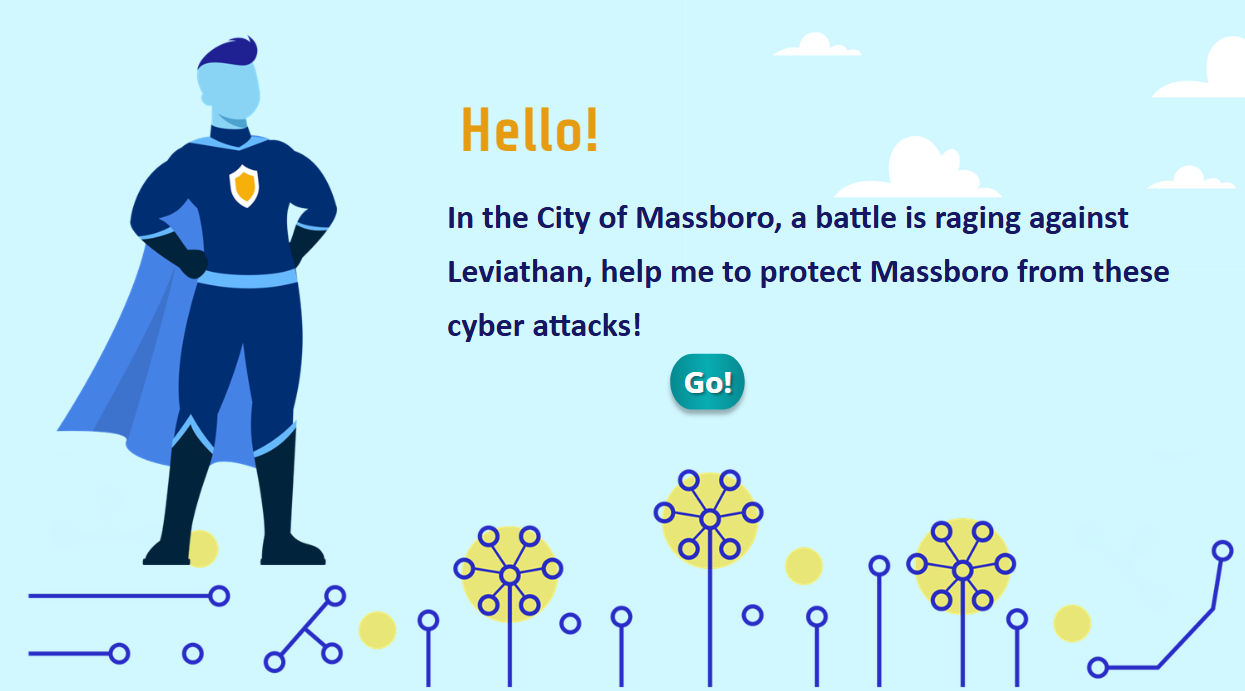
Once the scripts were validated, our instructional designer storyboarded each course using adult learning principles. With the storyboards approved, our creative team brought the Massboro visual world to life, a blend of technology and the traditional Massachusetts town, with a cast of diverse characters ready to defend it from Leviathan. We developed the courses in Storyline 360, working two at a time, each one moving through internal quality review, a client review, and a final revision pass before it was considered done. Alongside the courses, we produced the video components and the supplemental PDF resources, one set for learners and one to help managers evaluate risk in their own departments.
The reason this sequence matters is that the story never leads the learning. The content is settled first, and the immersive world is built to carry it. That order is what keeps an immersive course from becoming decoration, and it is the difference between a world that teaches and a world that merely entertains.

Image description: A flowchart of how eResponders builds an immersive learning experience. Four shared steps run in sequence: content review, creative concept, learning objectives and outline, and storytelling. The flow then splits into two parallel tracks, instructional design (scripting, then storyboarding) and creative production (the Graphic Line). Both converge at a shared approval before Storyline module production begins.
When an immersive approach earns its budget
An immersive build asks more of everyone than a standard course does, so it is worth being honest about when that investment makes sense and when a simpler approach serves you better.
The clearest signal is content that people struggle to connect with, either because it feels abstract or because the stakes are hard to feel in the moment. Cybersecurity fits both. A weak password does not feel dangerous until something goes wrong, and by then the lesson has arrived too late. An immersive approach makes those stakes visible and shared.
Scale is the second signal. A single course that will reach a large and varied audience can justify a larger investment, because the cost is spread across everyone it serves. The MassCyberCenter training needed to reach municipal employees across the entire Commonwealth, at every level of local government, which is exactly the kind of reach that makes a substantial build worthwhile.
It also helps to know that an ambitious project can be managed responsibly, especially when public funds are involved. We structure this kind of work into defined stages, with each course moving through its own cycle of development, review, and revision, and with deliverables set out clearly from the start. Breaking the work into milestones keeps the scope predictable and the budget grounded, so an immersive build stays a considered investment rather than an open-ended one.
If your content is already concrete, tied closely to a specific task, and easy for learners to connect with their daily work, a straightforward course may serve you just as well. The immersive approach earns its place when the challenge is engagement and relevance, and when enough learners will benefit to make the effort worthwhile.

Image description: Graphic titled “When is immersive learning worth the investment?” A teal band defines immersive learning as placing the learner inside a story, making decisions and seeing what follows. Below it, two panels. Signal one, technical content, learners need a safe space to practice. Signal two, a large, varied audience, cost spreads across everyone it serves.
Inside the Massboro Universe
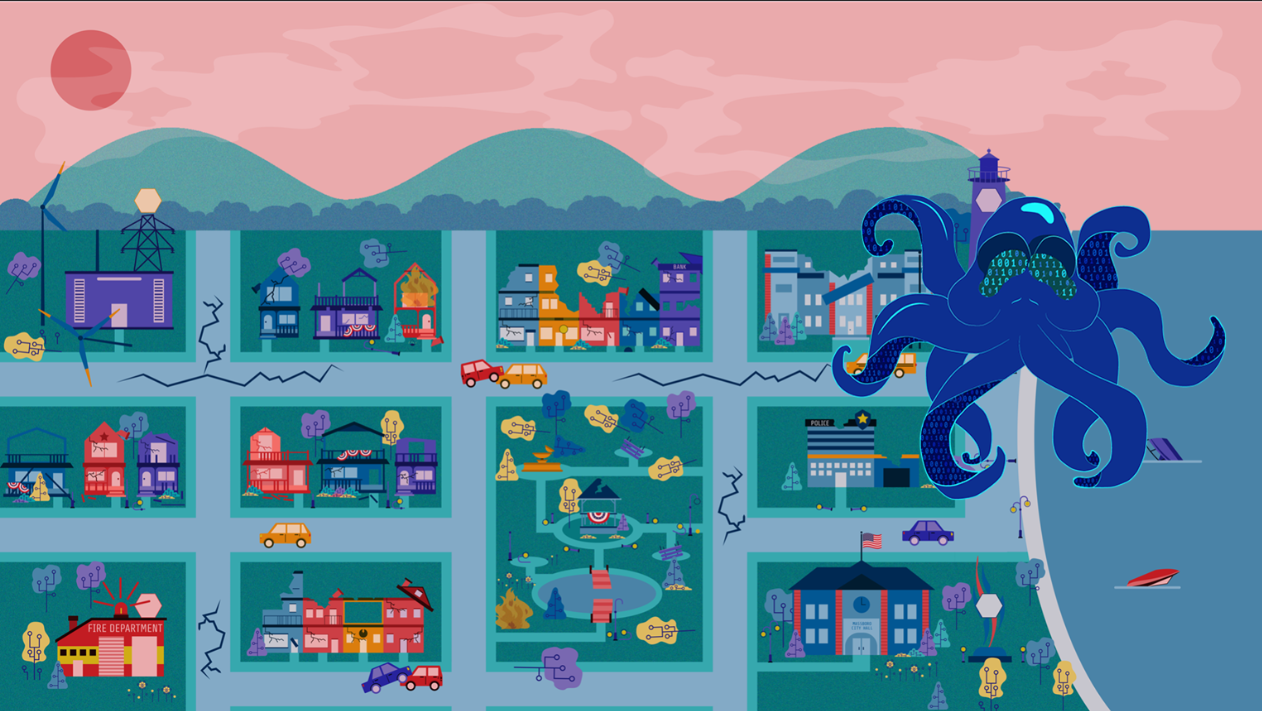
The creative heart of this project was a fully original fictional world. We created Massboro, a coastal Massachusetts municipality brought to life through custom illustration and graphic novel-style animation.
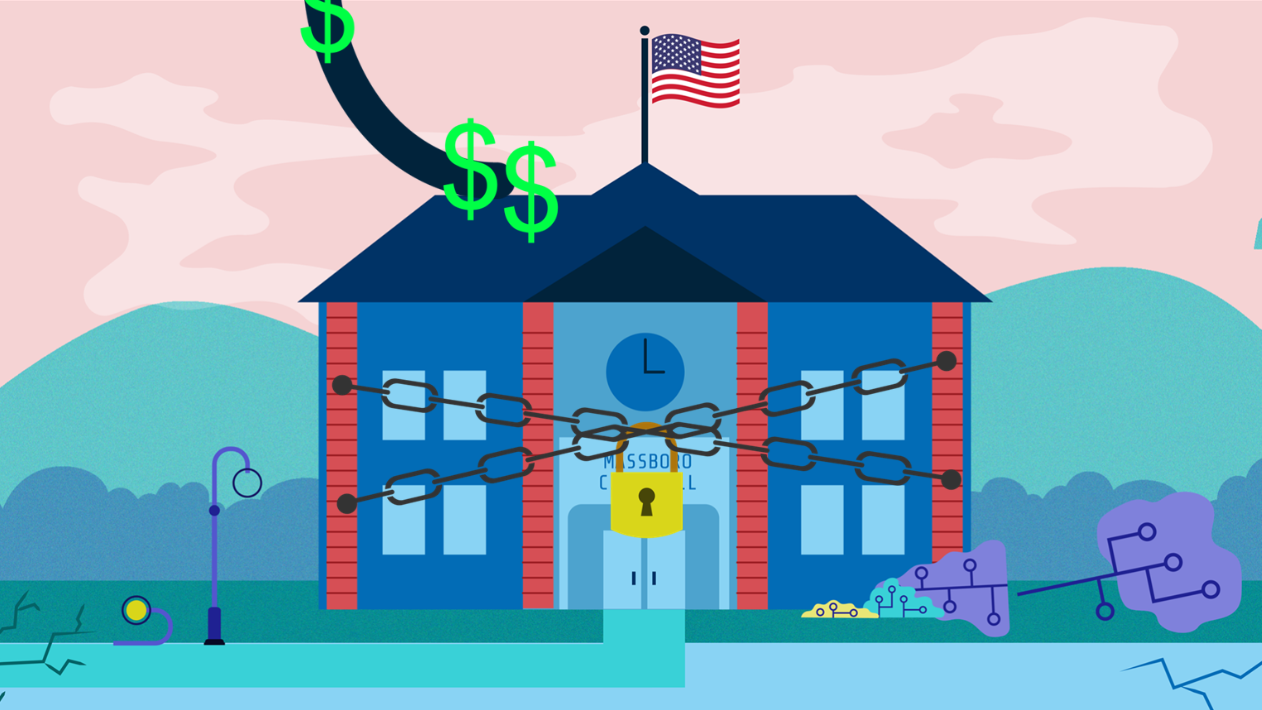
The story opens with Massboro falling victim to a ransomware attack carried out by Leviathan, a malware monster made of code that rises from the water and wraps itself around the city, freezing files and bringing municipal services to a halt. From there, every course is woven into the story of how Massboro responds and recovers, with municipal workers cast as the ones who defend and restore their city. Custom characters, environmental art, and animation give the stakes a shape learners can see.
The expert content had a home in the story too, delivered through Massboro News, an in-universe broadcast that carried interviews with real cybersecurity experts, blending live footage with animated visuals.
Several deliberate design choices sit underneath that world, and they are what make it work as instruction rather than entertainment.
Massboro is calibrated to feel like a real Massachusetts municipality, from the welcome sign to the town-name convention, without being any single actual town. Learners recognize their own context enough to see themselves in it, while the training stays relevant for everyone taking it, no matter which town they serve. It is recognition at the level of “I work in a place like this” rather than “this is my town,” which is what lets one fictional scenario serve every municipality in the state.
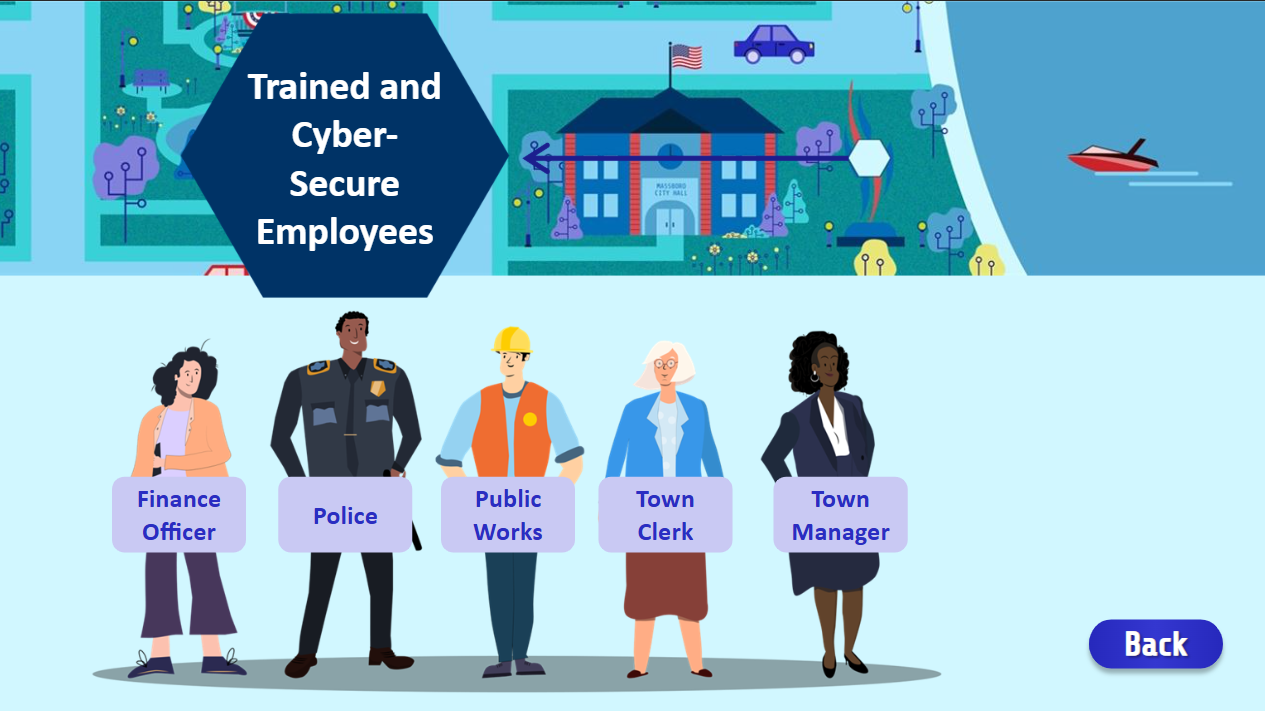
The familiar municipal roles, the town clerk, the police officer, the fire department, the mayor, appear as heightened versions of themselves. This signals that the training still maps to a learner’s real job and real responsibilities, while giving room to dramatize what is at stake. Leviathan as a shared external threat makes the danger visible without relying on real breach scenarios that can feel punitive or frightening.
The message that everyone has a part to play is built into the structure of the story rather than stated on a slide. The baseline principle of shared responsibility lives inside the plot, so learners absorb it through the way the story works rather than being told it directly.






Why we built a whole world to teach cybersecurity
Cybersecurity training could easily have been a set of straightforward courses, and it would have been accurate. The question we kept returning to was whether accurate would be enough to change what people actually do at their desks. Think back to the municipal worker from the start of this post. She already carries a full load of tasks, and her attention is likely stretched thin, so a straightforward course would not serve her as well as an immersive learning experience. By grounding technical content in a story and in characters, the work becomes something learners can see themselves in, which is what gives it a chance to stay with them.
For the MassCyberCenter, this meant a training program that municipal workers could fully engage with, built to be accessible to learners across abilities and delivered in both English and Spanish so it could reach every community in the Commonwealth. The world of Massboro turned what could have been a compliance exercise into an experience with a real chance of being remembered.
Common questions about immersive learning
What is immersive learning?
Immersive learning places the learner inside a story, world, or scenario where the content plays out around them, rather than presenting information for them to absorb. By making learning feel like an experience, it supports stronger engagement and better retention, especially for content that can feel abstract.
When is an immersive or scenario-based approach worth the investment?
It makes the most sense when the content is hard for learners to connect with or the stakes feel abstract, and when a single course will reach a large or varied audience. If your content is already concrete and closely tied to daily tasks, a simpler course may serve you just as well.
How do you make compliance training engaging?
Grounding the material in a story and in familiar roles helps learners see how it maps to their own responsibilities. Making the stakes visible and shared, and building the core message into the structure of the experience rather than stating it on a slide, keeps learners active rather than passive.
Does storytelling improve knowledge retention?
Storytelling gives learners something to associate the content with, which makes it easier to recall later. A memorable narrative can surface the right lesson at the moment a learner needs it, which plain informational content often struggles to do.
Bringing an immersive approach to your own training
Not every course needs its own world, and part of our work is helping organizations tell when an immersive approach is the right fit and when something simpler will serve them well. If you are thinking through a project where engagement and relevance are the real challenge, we would be glad to hear about it and think it through with you.
